Tribute to Bell
December 14, 2011 § Leave a comment
Hi, Felicia. I want to tell you about our black maid/caretaker/cook/second mother to me. Here are the facts. Ada Bell Young came to work for my family when I was two years old, in 1950. She lived with us. She was not married but had several brothers and sisters, most of whom lived in Laurens, SC. Bell owned the house they all lived in and had several pieces of furniture there from my Daddy, who owned a furniture store. The floors were covered in carpet sample squares, all different colors, and the walls were covered in wallpaper sample squares. I loved this house and thought of it as the “patchwork” house. Bell went to Laurens one weekend a month and otherwise lived with us. Bell did all of the cooking and cleaning for us as well as some yard work, which she liked. She grew peanuts in our back yard and beautiful flowers. Bell baby-sat me, took me on the city bus to town…to Woolworth’s…bathed me, fed me, etc., etc., etc. I have letters she wrote me when I was away at summer camp and when I was in college. Bell finished the third grade and then had to work in the fields and pick cotton, but she could read and write…just not well. I loved her dearly. My parents also loved her and heavily depended on her. They, however, grew up in another generation, in the Deep South, and could never get over their life-long prejudices, specifically against “people of color”. Therefore, Bell’s bedroom and bathroom were in the basement. When I was older I sometimes argued with them about Bell having to sleep in the basement, but only succeeded in making them defensive and angry. I miss Bell every day of my life and wish I could tell her how she meant to me. I look forward to reading your blog.
Linda Quinn Furman
Fiesty Maid
November 28, 2011 § 1 Comment
I have the honor of introducing you to Tomaca Govan, a new friend and a possible cousin of mine. She is the Founder and Editor of the blog, Women Move the Soul. We met through LinkedIn. She is a colleague and cousin of a friend who had been very helpful to me in creating a documentary film entitled Shared History. Tomaca tells us some of the memories her mother shared with her about spending a few months as a maid in the World War II era.
My Mom was born in 1922. When she came of college age, she was on the waiting list for nursing school. While waiting, she was one of several maids working for a wealthy white woman in Maryland. She’s told me some very interesting stories about the few months that she worked there including how all the maids had to share their rations with this woman because during the war [WW II) people were given rations for food and things like that.
Even though the maids were required to share their rations with the Mrs., they were not allowed to eat the “luxuries” such as butter. My mother insisted on eating butter whenever she wanted to because they were her rations, so why shouldn’t she have some? The other maids did not and they would fuss at my mom for her lack of proper etiquette… : )
My mother was the youngest of 5. Her mother died when she was two. Her only sister was 7 years older and took care of my mom like she was her child. Her father remained a single parent for the rest of his life. My mother was his favorite and was very spoiled, sheltered and catered to. She was the baby so everyone protected her. That’s why she had a certain amount of feistiness when she started what was her first job as a maid.
But, she was there for less than a year because she was eventually called to school. And she was really glad about that because she had no interest in being someone’s maid.
Also, in terms of my mom working as a maid – she refused to call the woman’s daughter Miss ____, because the daughter was younger than she was. All the other maids kept telling her to call her Miss ___ so she wouldn’t get in trouble, but she was never reprimanded for that and stuck to her guns.
One of the maids was responsible for polishing the silver on a regular basis. She would make a grand presentation of pulling it all out and then polishing only a few pieces and putting everything back. The silverware was never used, so she felt it was a waste of time.
When my mother started working as a nurse, there was a white police officer who had been shot and brought to the Black hospital because it was the closest. They performed surgery and saved his life. The next day, his family and people from his job wanted to move him to a white hospital, but he insisted on staying there because “these people saved my life.”
Blacks and whites have a very rich history [together] and is something that his not taught in schools. I really feel fortunate to have met you and to have access to the information that you are putting on the internet. You give us light.
Balanced review of THE HELP by VISIONS’ Executive Director
September 28, 2011 § Leave a comment
Visions, Inc. executive director Dr. Valerie Batts has written a straight forward and balanced view of The Help that I wanted to share. The link is http://myemail.constantcontact.com/VISIONS–In-Our-Opinion–THE-HELP.html?soid=1102645492743&aid=eKJMe45QUvE#fblike. Visions provides consulting and training in diversity and inclusion. The article was forwarded to me via Coming To The Table, http://www.comingtothetable.org/, a program that is addressing the legacy of slavery in the US through stories related to slavery’s legacies under the topics of history, healing, connecting and action. Coming to the Table members are descendants of enslaved people and slaveowners from the same plantation property before the Civil War. The orgainzation was launched when people whose ancestors were connected through an enslaved/enslaver relationship realized they had a shared story that remained untold. Today, they and many others believe that the legacies and aftermath of slavery impact our nation in seen and unseen ways and they are committed to writing and telling a new story about our nation’s past and the promise of our collective future.
Also see www.sharedhistory.org, my own story of descendants coming together at Woodlands Plantation in South Carolina.
THE HELP: A SATAN’S SANDWICH?
September 15, 2011 § 4 Comments
THE HELP: A “Satan Sandwich?”
I read the book The Help last year and have seen the movie now twice. I’ve read at least 13 film reviews (from the New York Times and the Rolling Stone to the Christian Science Monitor and the Hollywood Reporter) as well as several academic responses (see the rather strident statement from the Association of Black Women Historians at http://www.abwh.org/ ) and innumerable comments from bloggers. From a term used recently by Representative Emanuel Cleaver regarding the August debt deal, it seems that The Help has created a “satan sandwich” of its own.
Despite all of the laments about stereotypes and the question about whether whites can write about black experience (check out the 1921 Pulitzer Prize-winner Julia Peterkin at http://www.virginia.edu/woodson/courses/hius324/peterkin.html) and the creation of two new magical negro characters (see The Rumpus blog below for an illuminating description), I decided I like “The Help.” I appreciate the struggle of the director to create a film on the subject of “help” in the 1960s. It would be controversial from any point of view. I’ve been looking at the issues of the impact of African American domestics on the white children they raised in the blog at www.justlikefamily.wordpress.com. I hope to open discussion about this complex and sometimes perplexing relationship and invite the biological children of the domestics to weigh in on what it was like to have their mother raise white children. « Read the rest of this entry »
Help For The Junior League
September 12, 2011 § 1 Comment
Help for the Junior League
Reviewers and bloggers have talked little about the stereotypes of white people created by the recent movie, The Help. The portrayal of the white women of the Junior League made me wince as much as the portrayals of some of the African American women, so I thought I would provide some information about the real Junior League. The Junior League is an international organization of women committed to promoting volunteerism and to improving the community through effective action and leadership of trained volunteers. In my hometown of Greenville, SC, a local group of women, which included my great aunt, started a Junior Charities in 1929. My mother was president of the organization in the fifties, when it became the Junior League of Greenville. My older sister was president from 1983 to 1984.
In the 1970s, it was my time to join. I declined to be considered for membership because I felt it was an elitist organization mostly based on someone’s idea of who “came from a good family” and who had social status. (Now, I realize, those with social connections are usually the most effective fundraisers.) And there were no black members then. According to the Greenville, SC, 2011 manual, after a period of organizational soul searching beginning in the 1980s , the first black woman was invited to join the Greenville Junior League in 1988. A multi-League diversity task force initiative and a joint service partnership with the local chapter of Delta Sigma Theta, a national black women’s sorority, was conducted in 1993. The national Association of Junior League International elected its first black president in 1998. « Read the rest of this entry »
Nadema Nathara
August 11, 2011 § 2 Comments
From a friend: “Your story (about Luvenia Duckett) reminded me so much of my grandmother’s maid. Her birth name was Lena Barton but she changed it to Nadema Nathara when she converted to Islam. She never attended services as far as I know but she did avoid pork. She lived with my grandparents starting when she was 13 or so. Her mother and her brother moved from the south with her in the first decade of the 20th century. She could read and write but very little. When she did write more than a sentence, it was always in Iambic pentameter. This fascinated my mother. She was an excellent cook and house keeper. She would come up to the summer cottage with the family. They had a separate house for her that had electricity but no plumbing. When they travelled, my grandfather would only stop at restaurants that would serve her as well.
When my grandparents sold their house they bought her a small house of her own. The she would come and help my grandmother and my mother a few times a week. She lived a long time, outliving my grandmother and my mother. After my mother died, Nadema would come to the cottage every summer for her “vacation” and help us. The help consisted of occasional sweeping and doing the dishes, and bossing us around. She would never come and eat at the table with us in the house, in spite of many pleas. However, we (Don, Ann, Mary, an au pair, and Nademma) all went on a day trip to Ottawa and she had a great time. Travelling with the elderly and kids works out because they tire at the same time. Eventually she sold her house and moved to an apartment and was taken care of by her brother’s wife. She died a very old lady.”
From the documentary FREEDOM RIDERS
August 10, 2011 § 2 Comments
This will sound familiar to many of us. From John Seigenthaler, Birmingham, Alabama resident and Assistant to Robert F. Kennedy in FREEDOM RIDERS http://www.pbs.org/wgbh/americanexperience/freedomriders/:
“I grew up in the South—a child of good and decent parents. We had women who worked in our household, sometimes as surrogate mothers. They were invisible women to me. I can’t believe I couldn’t see them. I don’t know where my head or heart was. I don’t know where my parents’ head and heart were, or my teachers’. We were blind to the reality of racism and afraid, I guess, of change.” The reference to “invisible women” reminds me of the compelling work of artist Rodney Grainger (mentioned in previous posts–see photographs) who creates images of domestic workers fading away or faceless behind their white charges.
BLACK IN WHITE
August 3, 2011 § Leave a comment
 Black and White – Artist Rodney Granger
 Rodney Grainger is an extraordinary artist working with the same themes as Just Like Family. In his own words:
Born in Birmingham, Alabama in 1948 and raised by an African American nanny in racially segregated Birmingham of the 1950’s and 60’s, my wonder for the great paradoxes of that
relationship has never ceased. Ultimately visual images from this experience would ignite an artistic attempt to understand deeper human connections lying below those divisions within race, class and gender.
For this narrative series Black in White, I have chosen to draw in charcoal rather than painting with color because drawing is so closely aligned to writing. Black and white imagery also serves as a primary language of dreams and the unconscious and I believe is best suited for a graphic awakening the imagination.
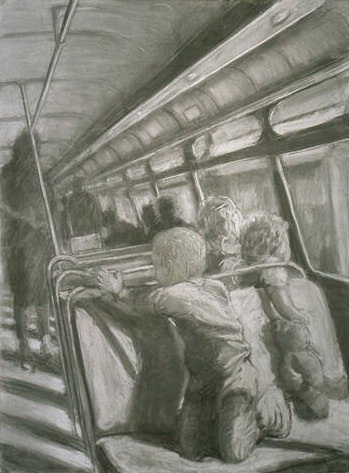


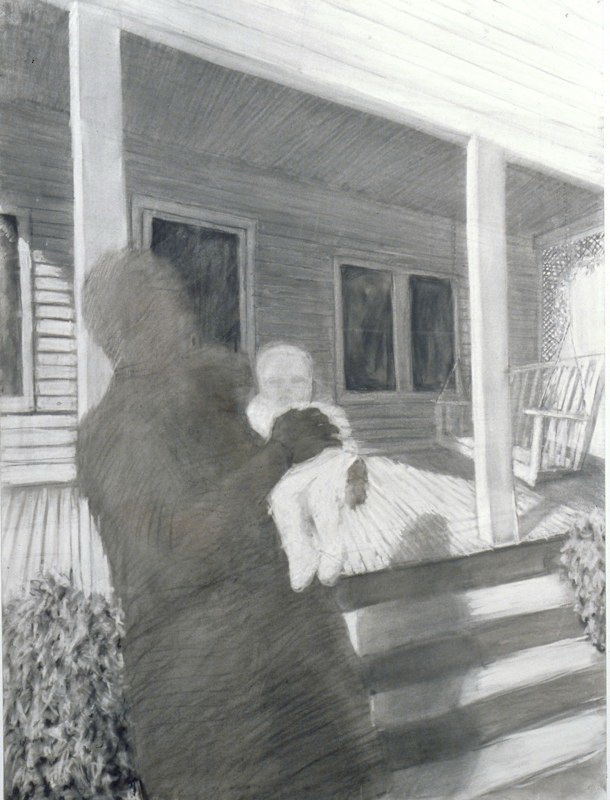 Grainger’s images are haunting and remind me that these early connections to a caretaker are mostly unresolved for many white people raised by African American women. It must have been deeply troubling as a child to hear of the race riots in Birmingham during the 1960s. Did he understand what was happening at the time?
Visit http://www.beaconhillartiststudios.com/BeaconHill/Works_on_Paper/Pages/Black_in_White.html#grid for more images of his work.
Just Like Family
August 1, 2011 § Leave a comment

 “Transparent” by Rodney Grainger
Welcome to the Just Like Family bog. Please open the INTRODUCTION post [June, 2011] first for more detailed information about the blog. Thank you.
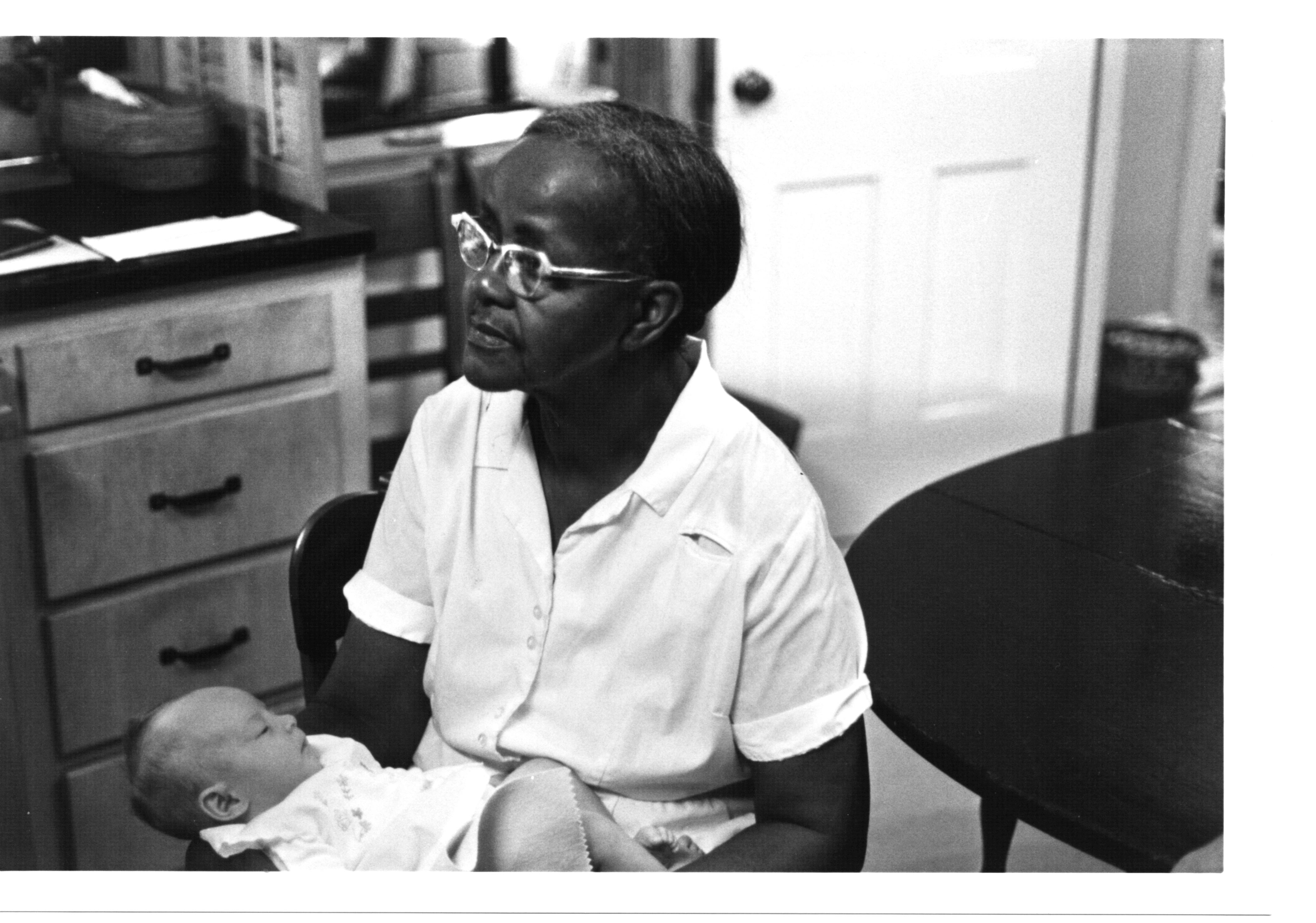
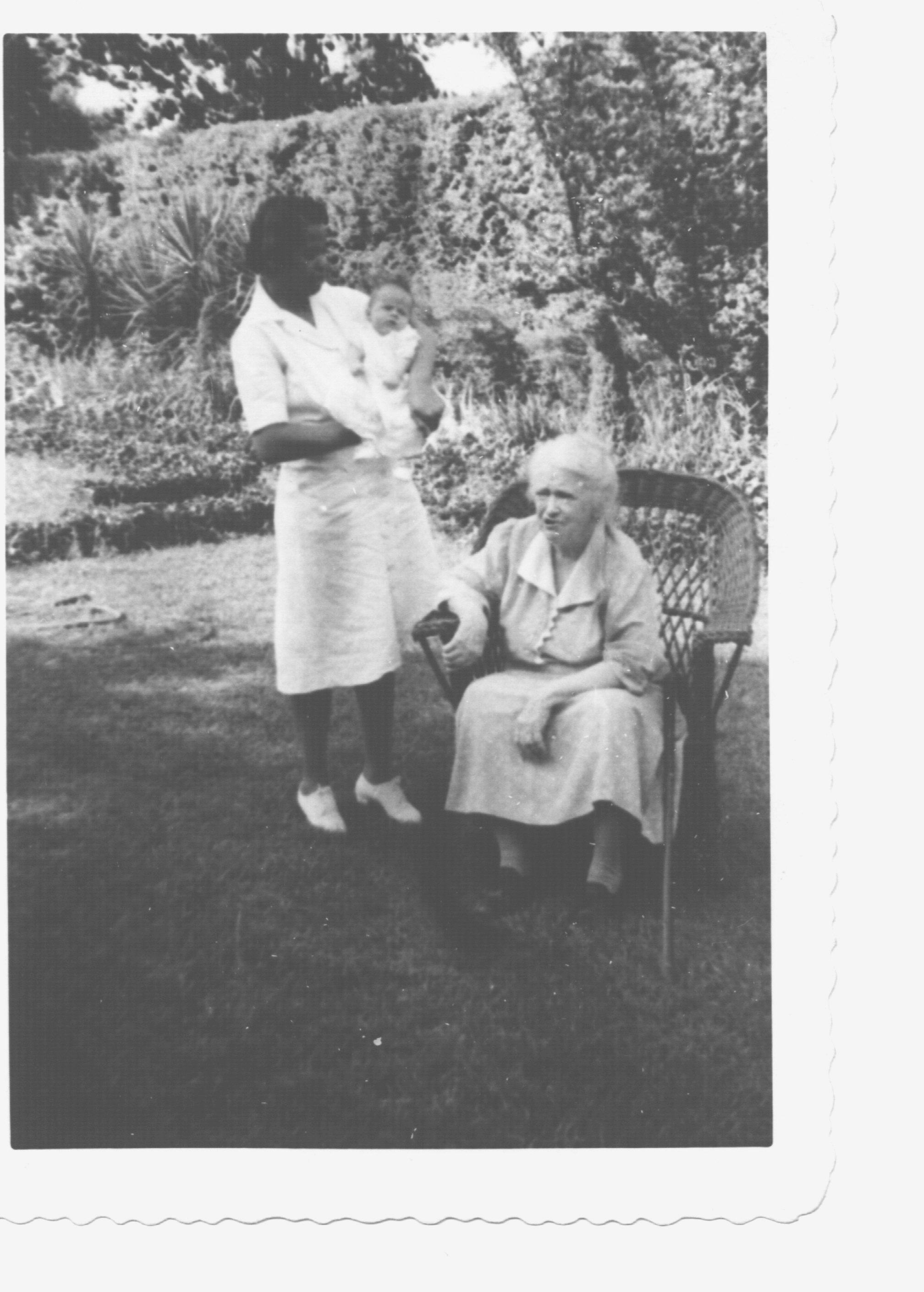

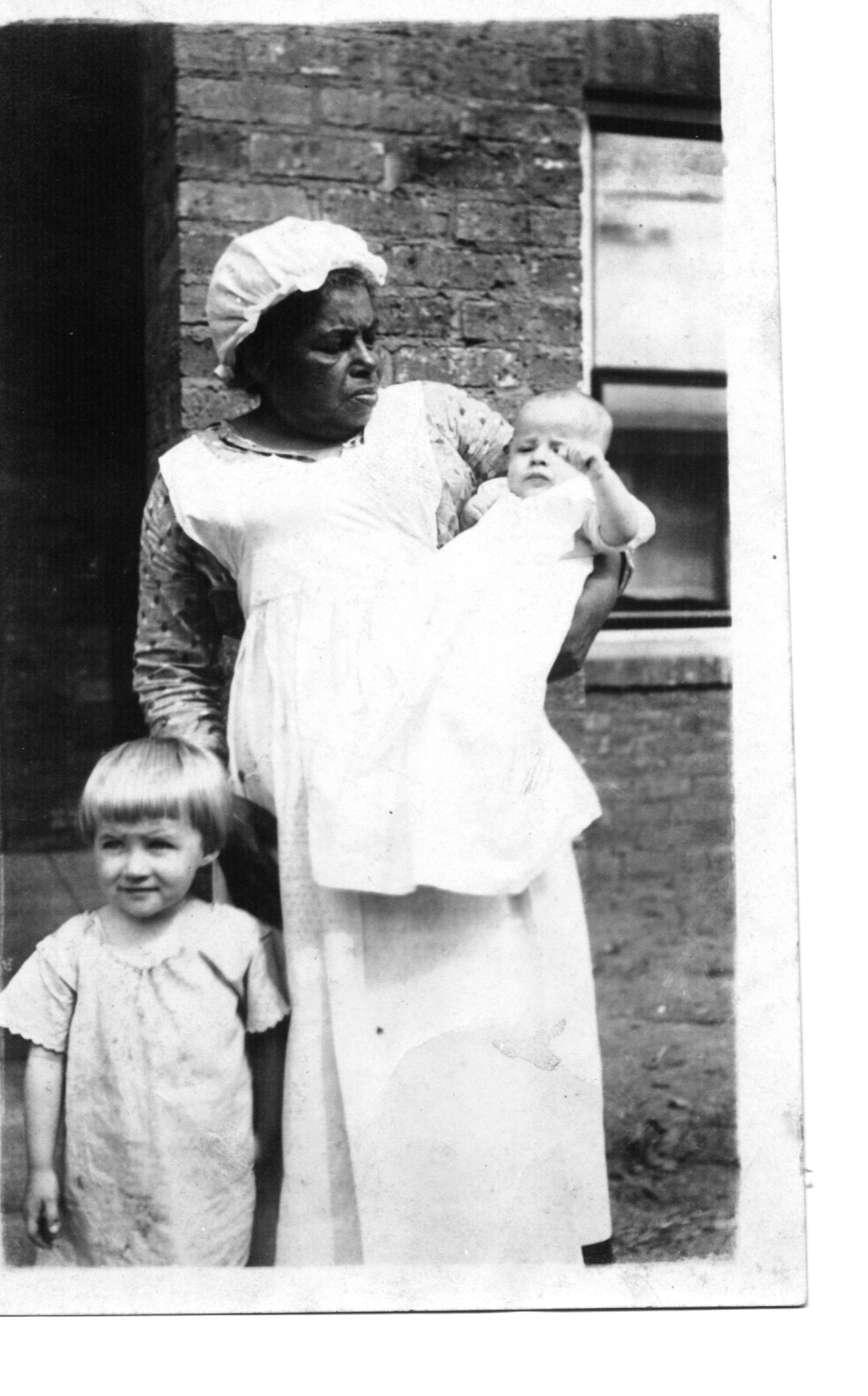
Luvenia Duckett (1906 – 2005)
July 11, 2011 § Leave a comment

Luvenia Duckett (1906 - 2005) with my neice Mary Earle.
about all the biscuits she had made for my mother for parties and receptions. She would just hang her head–tired of thinking about those biscuits. Once I tried to get her to let me videotape her making biscuits. She agreed but would place herself in front of the camera so you could not see her preparations. She would just laugh when I ask her to move. She and I were allies of sorts. We would save pieces the of white meat of the chicken for my dog. She would make a large biscuit for me that I could have later. She and I would sit in the pantry together when it thundered. I sat there with her because she was afraid of lightning. She recalled the time when she saw a lightning fireball come down the chimney, cross the room and go out a window. « Read the rest of this entry »
 JUST LIKE FAMILY